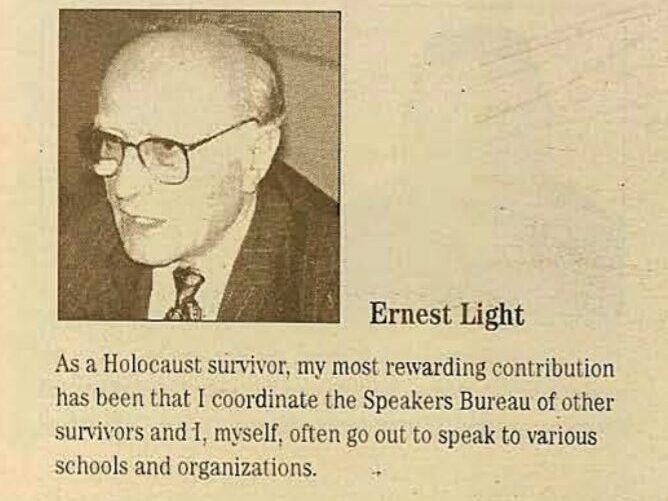

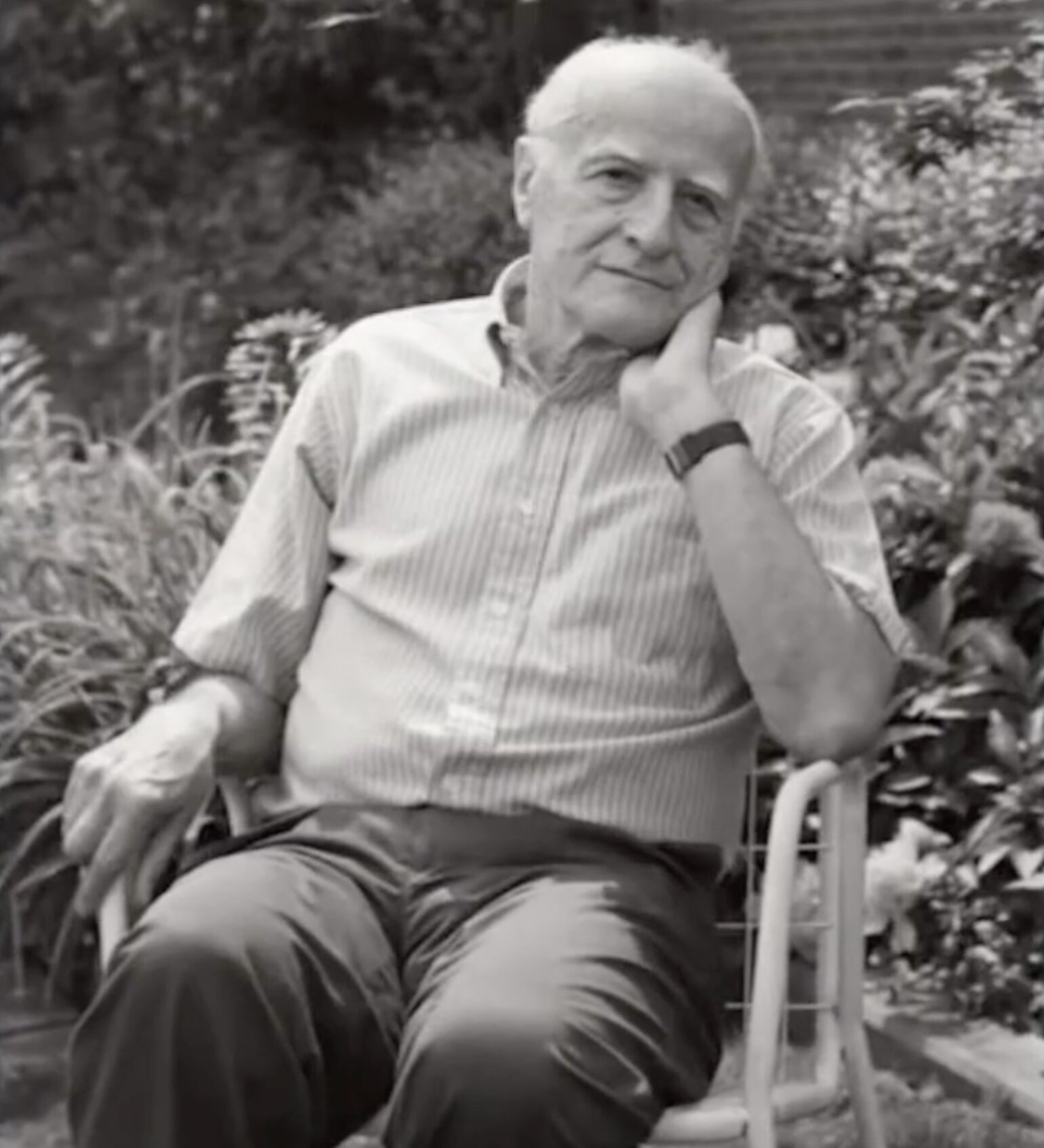
Ernest Light (z”l)
July 9, 1920 – November 11, 2011
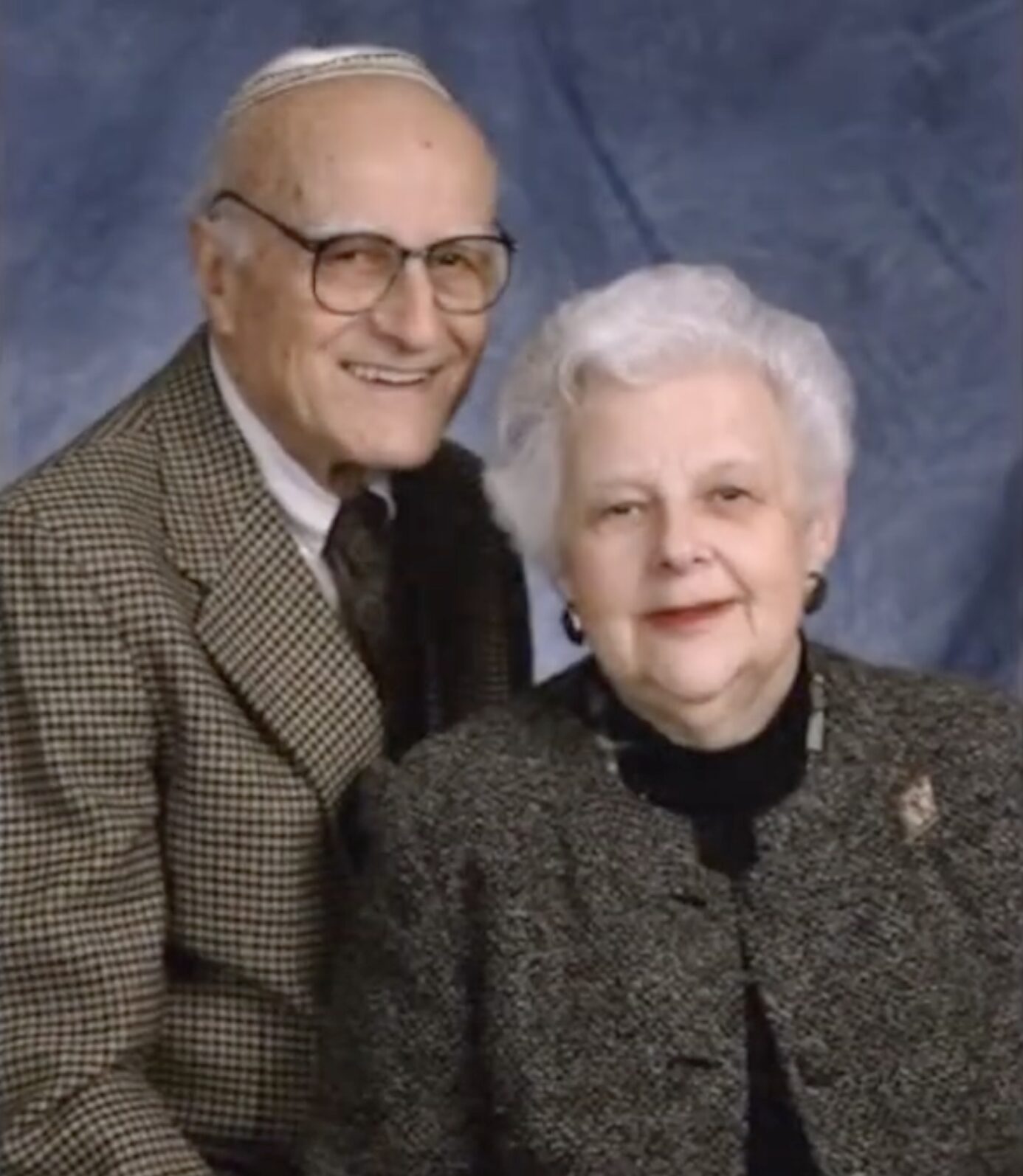
Ernest Light was born on July 9, 1920, in Uzhorod, Czechoslovakia, the son of Herman and Serena Polak Light. During the Holocaust he was at first in various forced labor camps in Hungary and Transylvania. In 1944 he was discharged from a hospital in the labor camp in Bor, Yugoslavia and returned home to Horlyo, Hungary. Later that year he was taken to Auschwitz and from there to Warsaw, Dachau Concentration Camp, and Muhldorf Concentration Camp. Ernie had five brothers and four sisters. Only three brothers and one sister survived the Holocaust. His parents, two brothers, and three sisters perished. He and his wife, Sara, had two children and three grandchildren.
You can watch a clip of Ernie’s testimony from The Holocaust Testimony Project or read his stories from Flares of Memory: Stories of Childhood During the Holocaust below.
An Unforgettable Passover Seder by Ernest Light
April 8th, 1944: Passover.
The table was set with our special dishes, wine, herbs, and matzos. Elijah’s cup, filled with wine, rested at the end of the table where I was. Our family around the table consisted of my father, mother, sister, her two-year-old daughter, andmy three brothers.
It was just about seven weeks since the Germans had occupied Hungary. You could see on everyone’s face concern about the future. But reading the prayers in the Hagadah, we temporarily forgot the present.
Suddenly our neighbor’s daughter burst into the house. Almost hysterical, she screamed, “Hide me, hide me! I just ran away from a German soldier. He tried to grab me!”
Without thinking about the consequences, we pushed her into the next vroom, where she hid herself. Everyone sat calmly and continued reading the Hagadah. My father led the prayer.
Following Passover tradition, we had not locked the doors, so that the Prophet Elijah could come in and join us at the Seder. This is how it was that a German soldier could just walk in, a gun over his shoulder.
Since I sat at the end of the table, he stood closest to me. I could feel his breathing behind my back. We continued to read as if we didn’t notice him. He stood there for a while—I don’t know whether it was two minutes or ten minutes. Then he turned around and left.
For the last fifty years, I’ve been wondering what made that soldier leave without inquiring about the girl, or threatening that we had to tell him where she was. I’ve come up with several possibilities:
—He thought that people who were hiding someone could not sit so calmly, conducting services.
—The German military command warned the soldiers not to commit any unnecessary violence, not to alarm the local population.
—He just might have been a human being.
• • •
I’ll never know the truth.
–Flares of Memory: Stories of Childhood During the Holocaust
In the Dark by Ernest Light
The Germans were excellent at deception, at keeping us in the dark. They invaded Hungary in March 1944. After Passover, on April 18, Jews were ordered to pack up to fifty kilograms of the most important necessities and gather at the synagogue. They told us we were being sent to Germany to work, because the German men were fighting in the front lines.
They took us by train to a nearby city. That evening, my family—my father, mother, brother, sister and her child, and I—found ourselves in an abandoned brick factory, in cramped quarters. Every day more people arrived from the surrounding commmunity.
All kinds of rumors circulated about where we would be taken. Some said to Austria, some said to Germany. On May 24, all of us were told to pack up again, that we were being “relocated.”
The next day we arrrived at Auschwitz. We had no idea where we were or what to expect. As we got off the freight wagons, SS men with dogs and a whole crew of men in striped uniforms hollered, “Heraus, heraus, schnell, schnell.” Most of us were in a daze—children crying, holding on to their mothers’ skirts and dresses; older people had to be carried out.
The women were sent to one side, the men to the other side.
Then came the selection. I alone from my family was sent with the young men who seemed to be in good health. The older men and children—my father and brother among them—were sent to the other side.
Those who were selected to our side were ordered into a big barrack where we were told to undress, put our clothing in order, and remember where we left it, so that when we got back from the showers we would have no difficulty finding it. When we came out of the showers we didn’t have to look for our clothes. Each of us got a striped uniform and a pair of clogs.
In the morning came the same reception, “Heraus, heraus, schnell, schnell.” As we assembled in the courtyard, we inquired about our families from those who had arrived a few days before us. They answered us, “Look up.” We saw smoke and smelled the stench. “This is where your family went to,” the prisoners told us.
We were handed cards to fill out the vital information—date of birth, name, home country, and occupation. At that time Jews from Hungary were arriving daily at Auschwitz, by the thousands. The Germans had to send some of us to other camps to make room for the new arrivals. About the third day, the stronger ones were put on a train and taken to Warsaw. Here we met prisoners from Bohemia, Slovakia, Belgium, and Greece. They told us where we were and what our job would be.
The next day I filled out another card. Again they wanted all the vital information. Only one thing was different this time: they used the cards of those who had perished during the early spring, after a severe winter. The used side of the card had the name and number of the deceased one. I wound up with the number 3339.
Two days later, about twenty of us were told to line up separately, that we would be taken somewhere else to work. A military truck pulled up, and we got on. A canopy was put over us so we couldn’t see where we were being taken to.
The dark under the canopy was nothing new to us.
–Flares of Memory: Stories of Childhood During the Holocaust
How Many Made It? by Ernest Light
Content Warning: This story contains descriptions of violence and death. Reader discretion is advised.
b. Uzhorod, Czechoslovakia (became Ungvár, Hungary), 1920
In the last days of July 1944, as the Russian troops were approaching Warsaw, the Germans decided to evacuate the Warsaw labor camp.
Orders were given to be ready for the next morning’s trip. Old and sick people were not to take part in the march; they would be taken by wagons. (Of course, those who stayed never left the camp. They were shot and disposed of.) In the morning about thirty-five hundred of us were assembled, counted, and recounted. We were on our way. As we walked we saw the Poles looking at us from their balconies, windows, and streets. “You yids will not last long. It’s about time to get rid of you,” they shouted.
One or two said, “Don’t give up, the war will end soon.”
We marched without food and without water. The sun beat down on us. Those who fell or couldn’t keep up were gotten rid of by the Germans on the spot.
At midday we reached a river. We were permitted to drink from the slimy, stinking water. While we were in the water, the German guards watched us from the bridge. After a short while they shouted at us, “Get out of the water, schnell.” Most of us ran out. Those who either didn’t have the strength or didn’t hear the orders were machine gunned. One of the victims, I remember, was a young man who was deaf.
The river ran red with blood.
Arriving finally at the town of Kutno, we waited for cattle cars to pick us up. The heat continued to be unbearable.
The train trip was the worst experience of all. Squeezed together, we endured more heat, hunger, and above all thirst. Thirst is almost impossible to describe: it does things to you, both mentally and physically. Many hallucinated, went berserk. After a day or two many died.
Those who survived at least had more room to lie down. Either they lay on top of the dead, or the dead were piled up in a corner to make room.
I don’t know how we managed to get out of the cars when we arrived. I felt barely alive. I haven’t the slightest idea how many of the thirty-five hundred who left Warsaw, marching before the Russian Army, reached our destination at Dachau.
–Flares of Memory: Stories of Childhood During the Holocaust
A Surprise Package by Ernest Light
It was a cold, rainy night. Hungry and exhausted, we stood in line for hours while the Germans counted and recounted us, checking whether the number matched the number they counted when we left in the morning.
Finally we started back to camp. While stopping at a railroad crossing, I saw a German soldier with a gun over his shoulder approaching me. He was tall and looked well-fed, like all of them.
I wasn’t scared. My mind just wasn’t functioning.
Suddenly he slipped something into my hand. Surreptitiously, I glanced down at the package. It was a piece of bread.
Was I picked by chance that night? Did he do it every night, randomly choosing someone? One thing I do know—that piece of bread boosted my morale and strengthened my will to live. Despite all the inhumanity, there were human beings left in the world.
–Flares of Memory: Stories of Childhood During the Holocaust
An Ending and a Beginning by Ernest Light
Content Warning: This story contains descriptions of violence and death. Reader discretion is advised.
Around April 26, 1945, orders came to pack up our belongings—a mess kit and a spoon. The following morning those who had enough strength to walk were marched from Muhldorf Concentration Camp, near Dachau, to the nearby railroad station. We were loaded into cattle cars, for a trip of unknown destination. Most of us—there must have been about a thousand men—were emaciated and half-dead. Somehow the crowding was not a problem as in previous train trips. For the next two or three days we were moving back and forth, without knowing or caring about our destination or our fate.
At one railroad stop the American Air Force mistook our train for a German military transport, and turned their machine guns on us. Two men in my car were killed, as were men in other cars, and many were injured. Once the attack halted we managed to open the cars. We ran out to an open field. When they saw our striped uniforms and emaciated bodies, the shelling stopped. The following day, the Germans realized there was no place to take us. We were surrounded by American troops. Suddenly the car doors were opened. The guards disappeared and we were left on our own.
So that was the end of our captivity.
A group of about eight of us, who still had some strength left, took the first road we saw. We walked until we reached a farmhouse. The people gave us food to get rid of us.
Unfortunately, we had nobody to warn us not to overeat. Not that warning would have helped. It was impossible to resist the urge to eat after such a long time of starvation. The eyes just wanted to swallow everything. None of us thought of the consequences.
We ended up in an abandoned German military barracks. Most of us were bloated and very sick. Many died, and there was nobody to help us.
A few days later, in the evening, we heard shooting nearby. I thought, “The Germans are returning and this will be the end for us.” After a short time, the shooting stopped. In the morning we found out that the shooting came from American forces celebrating V-E Day.
The following day doctors, medics, and nurses came to our barracks. We were taken to a nearby sanatorium in Weileim, run by Sisters. Little by little, we gained back our strength.
The first day I felt better, I went for a walk. I headed for the center of the town. I saw a ballfield close by. American soldiers were playing a strange game with a small ball. I saw one man crouching with a mask on his face, throwing a ball toward the man in front of him, this man throwing the ball toward the man with the mask. The man standing in front of this man had a bat in his hand. Suddenly, the man hit the ball, all the men in the field with gloves on kept running, hollering, and throwing the ball.
This was my introduction to baseball. I never could have imagined that one day I would become an avid fan of this game.
So that was a beginning.
–Flares of Memory: Stories of Childhood During the Holocaust