Righteous Among the Neighbors is a project of the Holocaust Center of Pittsburgh that honors non-Jewish Pittsburghers who support the Jewish community and take action to uproot antisemitism. In partnership with the LIGHT Education Initiative and Mt. Lebanon High School, student journalists interview honorees and write profiles about their efforts.
Article by Lauren Rossetti
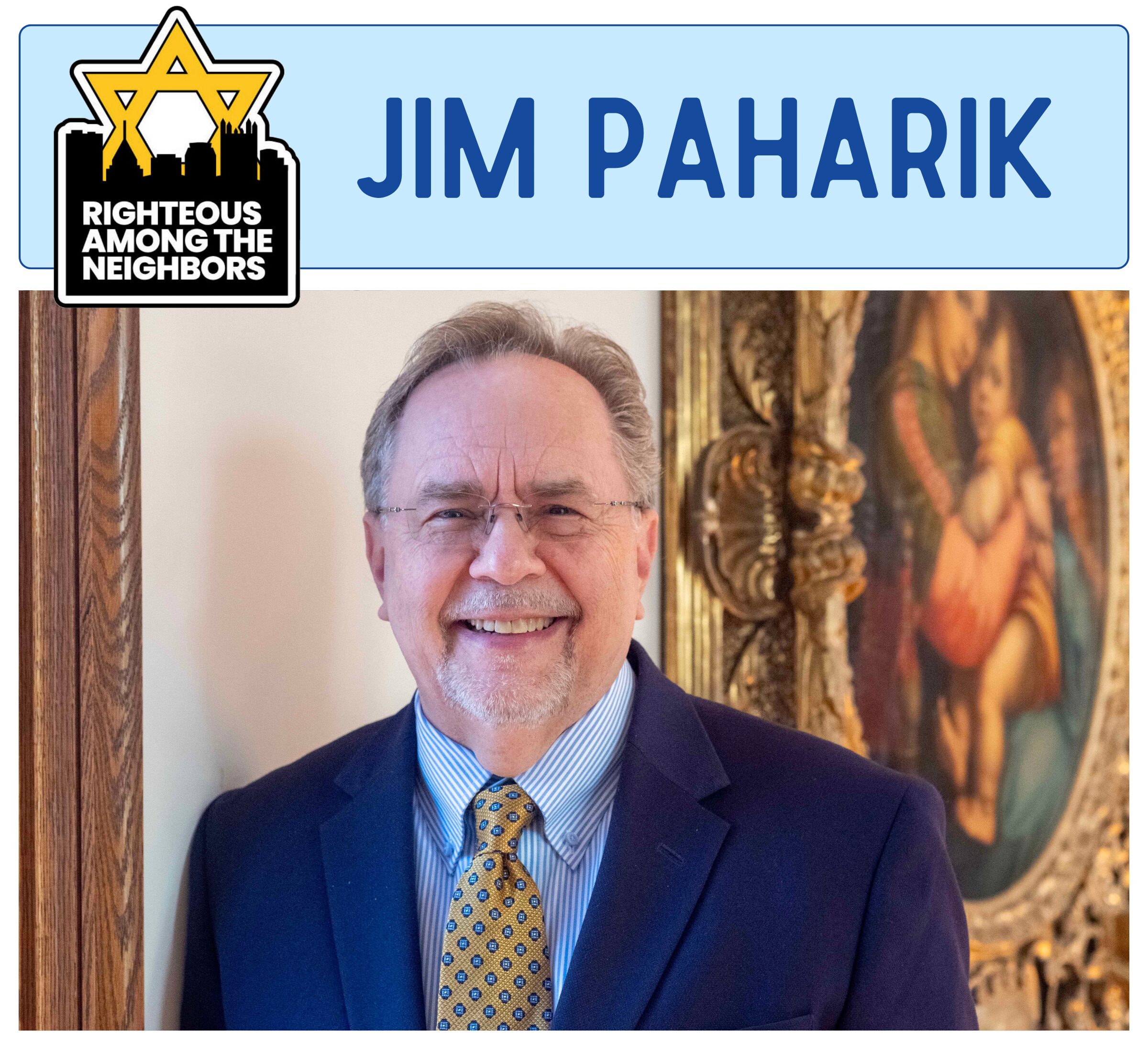
Jim Paharik, a professor at Seton Hill University who campaigns for Holocaust education through his work at the National Catholic Center for Holocaust Education, has been recognized as Righteous Among the Neighbors.
Paharik has lead the NCCHE since 2019 as someone who understands the importance of Holocaust education in regards to the weight of the past and the urgency of the present. “Jim is a person who builds community,” said Dr. Melissa Marks, a professor at University of Pittsburgh at Greensburg who nominated Paharik.
Marks has worked with Paharik on the NCCHE board since 2022, and has seen firsthand how Paharik brings the community of Westmoreland Country together. “Using Seton Hill’s National [Catholic] Center for Holocaust Education, he has led top-notch education conferences, offered amazing teacher trainings and designed an amazing masters program that two Pitt-Greensburg students of my acquaintance have attended.”
During his tenure, Paharik has worked to forward the goals envisioned by the Sisters of Charity who founded the NCCHE in 1987.
“Sister Gemma Del Duca and Sister Mary Noel Kernan viewed the work of the Center as a direct expression of the Catholic mission of their religious order and Seton Hill University, which focuses on a deep respect for Judaism and a commitment to upholding the dignity and sanctity of all human life,” Paharik said.
Among his many undertakings, in 2023 Paharik brought in the Violins of Hope to Seton Hill, a touring exhibit featuring a group of musical instruments rescued and restored from the Holocaust.
“The Shoah represented a fundamental attack on all that Catholics believe in,” Paharik said, “We must remember its victims and learn from that terrible tragedy in order to warn about and try to prevent such atrocities from occurring today and in the future.”
Another program developed by Paharik was a series of video recordings of second-generation children of Holocaust survivors. The Eva Fleischner Oral History Project, named after the late Dr. Fleischner, a distinguished Holocaust scholar and member of the NCCHE, aims to preserve their stories.
“I was one of the people invited,” Marks said. “I think what has personally impacted me most is Jim’s kindness and inclusiveness. He makes everyone feel like they are an important piece of the puzzle in doing the work of Holocaust education.”
With a dwindling Jewish population in Westmoreland County, Paharik’s work provides the county with resources and education it would not have otherwise.
“Jim’s focus is on social justice for everyone and that it is the duty of everyone to be upstanders,” Marks said. “He uses examples of Catholics during the Holocaust, but he applies those principles today,” Marks said.
Paharik’s work lays the groundwork for not only Holocaust education, but broader community togetherness. “Things that people could do to emulate Jim are to listen, form connections, find common ground and use all of that to work towards more equality, more equity, more inclusivity, and more respect in society,” said Marks.
Paharik’s life of academic and devout Catholicism has guided his aspirations, claiming his work in the Center is a “spiritual calling,” he said.
“It is informed by my life of academic inquiry into the dangers of totalitarianism and state-sponsored violence, as well as my desire to help bring about a more just and compassionate world,” Paharik said.”The goal of tikkun olam, which is a Hebrew term meaning ‘to heal the world’, has guided the Center’s work throughout our history, and will continue to inspire us into the future.”