

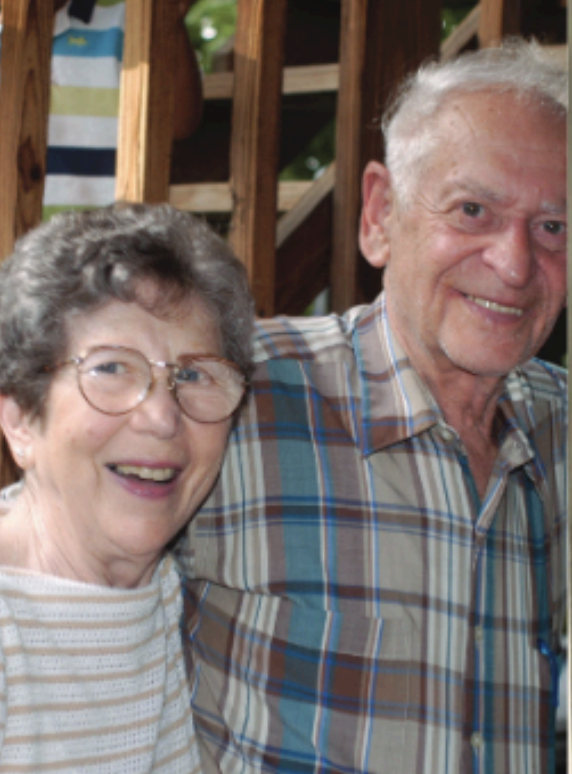
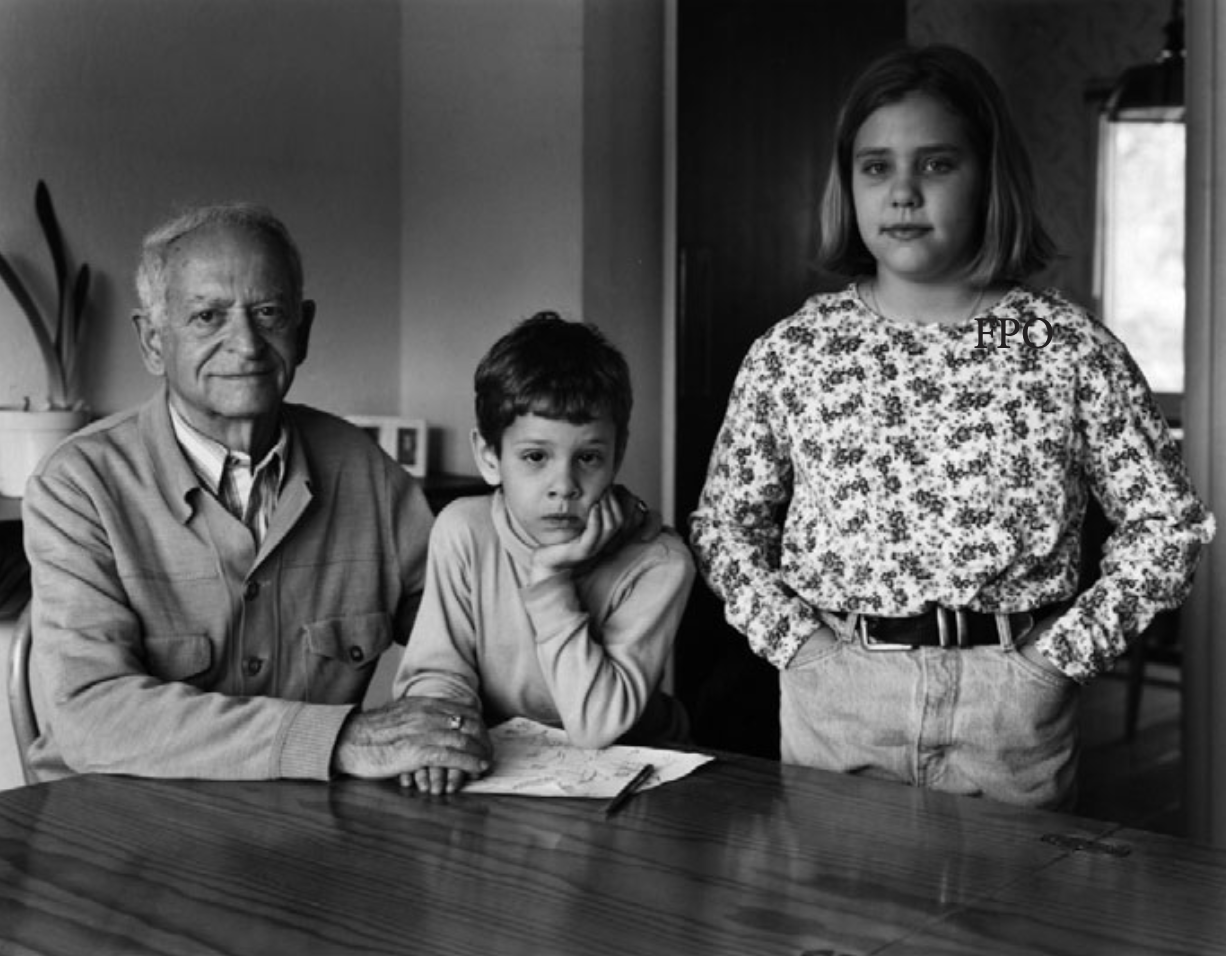
Leon Brett (z”l)
Leon Solomon Brett was born on September 6, 1922, in Skudvil, Lithuania, the son of Shmuel Elyeh and Shifra Leiserowitz Brett. During the Holocaust he was in Lithuania, first in a jail in Shavel, then in Shavel Ghetto, and finally with a partisan detachment near Shavel. After liberation he became a watchmake and married Sarah Luel Brett (z”l), who was in Łódź Ghetto, Auschwitz, and Mauthausen; they had three children together.
Leon had three brothers and one sister. Only his brothers, who emigrated to South Africa before the war, survived the Holocaust; his parents and sister perished.
Leon’s Writings from Flares of Memory: Stories of Childhood During the Holocaust
Life did not change much in Skudvil, Lithuania. Each day had its own routine. Saturday was the most special day. On that day everything came to a standstill. The change really started on Friday, when the Jewish mothers and daughters cleaned and scrubbed every room in the house. The tables were covered with white cloth and shiny brass candlesticks. Anticipation was in the air, the smell of Sabbath food in the homes. Before sundown the shops would close. Everybody felt loved by God, blessed by God. On the four streets and five alleys, Jews dressed in Sabbath garments and walked from their homes to the house of God. And the same was done Saturday morning and Saturday afternoon. That day was to be for God and man, and nothing else.
It was not only on Saturdays that Jewish men of Skudvil went to our shul. Three times every day—morning, afternoon and evening—every male partic-ipated in a service to God. Afterward, if one did not have to rush home or go to work, he would linger and talk with friends. He might discuss conditions in the country or how certain events would affect their lives. He would analyze news items from yesterday’s paper, news from foreign countries. Is it good or bad for the Jews? How could a pronouncement by the American President affect the Jews of America or even of other countries?
There were study groups that met every day. “To learn a page,” they called it. They studied from a tractate of the Talmud, analyzed the validity of a ruling by our sages, debated the meaning of a word and sometimes even of a single let-ter. Their debating never ceased.
My father belonged to such a group. He usually took the moderate, lenient approach, where the others adhered to the stricter ruling. They would say, “According to you, Reb Shmuel, everything is permissible.”
“Show me, prove it to me,” my father would respond. “Where in the Talmud can you find a prohibition against such and such?”
“Your permissive rulings are a sin. They will cause others to sin, it will be the ruin of our traditions, of our faith,” they would reply.
The argumentation would sometimes get heated, and they would accuse my father of apostasy. I heard them refer to my father as “the Berliner rabbi.” That hurt me, especially when I was still young. Could my father, who was so gentle and unassuming, and whom I loved very much, be guilty of sin?
In our synagogue you could see not only scholars but also ordinary people, standing in a corner and reciting psalms. Perhaps they were troubled and that was their way of unburdening themselves.
The door to our house of prayer was always open. It was common for a wayfarer who happened to pass through our town to spend the night there. He would use a bundle for a pillow, cover himself with his overcoat and sleep on a bench near the entrance.
It was only on Tuesday that our synagogue was practically deserted, except for prayer time. Tuesday was market day and most people had to attend to their stores and workshops. Farmers from villages all around came in their wagons. They would bring butter and cheese, eggs and poultry, to sell in the market, and then proceed to the shops to buy salt and sugar, thread and cloth.
The Jankauskas family would park their wagon in front of our house and spend the day with us. We served them sweet tea and white bread. They liked a lot of sugar in their tea.
Their son, Petras, always came along. He was about my age. Sometimes he stayed with us for a day or so. In the summer, we would go down to a stream and climb the trees, looking for a long branch to get the longest possible rod. We would tie a string to it, then a fishing hook to the string, and try to catch a fish. Sometimes I went along with the Jankauskas family after market and stayed with them, helping with the farm work. I slept in the barn on the hay with Petras. After a day or so, I walked home through the fields and along country roads.
Thursday night, from six to eight, was library night. People would come to the home of Meir and Feiga Krom to return books and get new ones. The Kroms set aside one room in their home for five hundred books of the library. Often library night would not break up at eight o’clock, but would last longer. It became a special event. Feiga Krom served lemonade and pastries. Some were round, thin and covered with sugar. Others were square, thick and filled with apples. Meir would read aloud a poem by Bialik and Feiga, a story by Guy De Maupassant. We would play the phonograph and quietly sing songs of joy, yearning, and hope.
The Kroms were one of the few families in town who had a radio. One day we turned it on while Hitler was speaking. His loud, hysterical voice was clear. The Jews, he said, stabbed Germany in the back and that’s why Germany lost the World War. Jews are capitalists, communists, planning an international conspiracy. He spoke of the Aryan master race, of communism and the threat to the world from the east. He finished speaking but the thunderous cheering of a multitude of voices lasted a long time: “Sieg Heil, Sieg Heil.”
Meir clasped his hands and said in a fearful voice, “There will be a war between Germany and Russia and we are right in the middle, so close to the German border.”
That night after we left Krom’s house and walked down Tauragu Street, no one spoke. Everybody was thinking about what Meir had said.
When I came home, my father and Dr. Dolnitsky were sitting at the table, drinking tea. The book of Job was open before them. My father was explaining to the doctor passages of Bildad’s response to Job. I told them of the voice on the radio and of the cheering, and that Meir had said there will be a war between Germany and Russia. Dr. Dolnitsky, who was very tall, rose from his chair, put his hands on my shoulders as he often did, and said, “Today’s gener-ation, so worried. I lived in Germany. I went to Heidelberg University. It will never happen there. Hitler is just an unpleasantness that will pass. Any other country, perhaps yes, but not in Germany . . . Nicht in Deutschland,” he repeated in eloquent German, as he was fond of doing.
My father walked to the window and looked out into the darkness of the night.“In the last war we ran all the way to Kremenchug in the Ukraine. At least I was young then. I could not run again.”
“You will not have to, Reb Shmuel,” said Dr. Dolnitsky, and bid us good night.
One morning in 1938, not long after that night, we found leaflets on the walls. They read: “Jews go to Palestine. We shall pave our streets with your heads.” They threatened to burn down our homes. We patrolled the streets all night, hoping to prevent them from doing it.
As time passed, we lived each day with uncertainty. Germany occupied Poland in 1939, but that was far from us. Then in June 1940, the Red Army marched into Lithuania. It was a sunny Friday. Truckloads of Russian soldiers streamed toward the German border. The artillery followed, then the tanks. It seemed like an endless stream of power, but Jews felt relieved. We felt we were safe from Hitler’s Germany. We knew our lives would change, but we thought that our lives would be safe.
The basic change under the Russians was that all Zionist organizations were banned. The Hebrew language was banned. We burned all Hebrew books at home and at the library.
Then came June 22, 1941. It was a Sunday. My father woke me. He was pale and looked scared. “It has started,” he told me.“The war between Germany and Russia has started.” Planes were flying overhead. We could hear the artillery. Truckloads of Russian soldiers were rushing to the border and the wounded were being taken away.
“Go, my child,” my father said to me. “Eighteen is not a good age in time of war. You must go away.”
My sister agreed. “What can they possibly do to us?” she said. “But you’re only eighteen. You must leave.”
Her two little girls were crying. The noise of war frightened them. They begged me to stay with them. My father gave me his round, silver pocket watch. “You will need it,” he said.
We embraced. I got on my English bike and left. When I looked back, I saw my sister, big with child, standing there crying helplessly. Her two little girls, Shifrale and Rivale, were holding onto her skirt, sobbing. Tears were streaming down their faces. I saw my father standing there. His face was white, and his beard gray. Tears were in his eyes.
That was my last glimpse of them. I never saw them again. I disappeared into the uncertainty of war.
I went east on my bike. German planes were bombing the highway. I saw a lot of people in clusters along the highway. They thought they would be safer than in town. It was fairly obvious that the Russians did not want to fight. They were defecting. I met a man from my town who was fleeing on foot. I took him on my bicycle and we fled east together. Tired from fear and travel, we stopped at a barn to rest. It was full of Jews, many of them children. Some cried and some were too scared to cry. We didn’t stay very long.
We continued east. Finally, we made it to Shavel. Shavel was a large city by Lithuanian standards, about 40,000 people. I came to my cousin’s house. Bombs were falling. We took shelter in a basement. And then it became quiet. I went up from the basement, looked outside, and there they were! The Ger-mans were on the street. The vanguard. They were on motorcycles, well-dressed and shouting orders to one another. I went to the basement and sadly told everybody, “They are here.”
Esther Levy used to live on our street. She hadn’t changed much in the years of hiding, except that she was pale and her countenance had hardened. We talked for several hours; she told me what had happened to the Jews of Skudvil, Lithuania.
I went to see her right after I heard that a Lithuanian man who lived near Skudvil was hiding a young woman from our town. At the time, I was with a Jewish partisan group moving about in the Lithuanian countryside. I went to my Lithuanian friend, Praniukas, and asked him to take me there. As always, he readily agreed.
I felt safe in his wagon—two peasant boys going to market. We timed it to approach the vicinity of the town when it got dark.
The Germans had occupied Skudvil the day in 1941 when the war between Russia and Germany started. At my father’s insistence, I had fled east.
The Lithuanians immediately had begun to terrorize the Jews. My father was one of the first victims, Esther Levy told me. Petras Staniunas came to our house looking for me. Because my father said that he did not know where I was, Petras slapped him and tore his beard. “I can still see the blood running down his face,” Esther said.
I vaguely remembered Staniunas. He was a teacher. He was always well dressed, in gray suits. He once said that he liked gray suits because that’s what the American president, Roosevelt, wore.
On the 23rd day of the month of Tamuz, all men were ordered to assemble at the market place. Staniunas was in charge and gave orders to his Lithuanian helpers. Our teacher, Oshrin, approached the German who seemed to oversee everything and asked him why only Jewish men were ordered to assemble here. Without any hesitation, the German shot him. He then asked if anyone else had any questions. Obviously no one did. He promptly motioned to the Lithuanians and they marched all men to a wooded area several miles away and killed them. “Your sister’s husband, Meir Sherf, also died that day,” Esther Levy said.
For some reason my father wasn’t there. But three days later, he and the rabbi from the neighboring village of Upine were taken away and forced to dig their own graves.
Several weeks later all women and children were taken away and put in bar-acks without roofs. “You can imagine what it was like when it was raining,” she said. She was with my sister, Feige Sherf, and her two children, Rivale and Shifrale. To calm her children, my sister would tell them that their father would come soon and take them home.
There my sister gave birth to her third child, a little girl. They named her Chaya, which in Hebrew means life. Esther Levy said, “She was a beautiful child and the marvel of the camp. We took it as a good omen. Certainly God would not bring forth a new soul and let it be destroyed. Our spirits were raised.”
Rebbitzen Masha recited from the sidur, which she was always carrying: “God is gracious and merciful.” She promised that for Rosh Hashana every-body would be home, and even the men would come back. How could a rabbi’s wife be wrong?
On the 23rd day of Elul, exactly one week before Rosh Hashana, they were all taken out and killed. Even tiny Chaya wasn’t spared.
“How did you survive?” I asked Esther Levy.
She said that several days before that happened, she ran away. She also knew of three other women and one young boy who were hiding out. “Including me,” she said, “as far as I know, only six of the thousand Jews of our town are still alive.”
The last thing she said to me was: “Your Mother Shifra was smart. She died a long time ago. Way before this war.”
We parted hoping to see each other after the war.
On the way back, Praniukas and I went through Skudvil. It was still dark.
I stood in the middle of the town where I was born and had lived for nine-teen years. I knew every house, every door and window. Jews had lived in all these houses. They were all killed, and Lithuanians lived there now. You mur-dered and also inherited. The destruction of my community was real. What did not seem real was that I was still living.
There in the corner, the church was still standing as secure as ever behind its massive stone wall. And it always will.
I went to our synagogue. They had converted it to living quarters for the Lithuanians. Our shul where we “learned a page” every day and prayed three times a day is no more and never will be.
We went to my house. Lithuanians lived there now. You murdered my family and inherited my house.
Staniunas came here, beat my father; blood was running down his face. My father suffered because of me, because I ran away. It was not an evenhanded struggle. Staniunas was born with a gun in his hand and hate in his heart. Reb Shmuel was born with a book in his hand and compassion in his heart. You see, a gun and hate are stronger than a book and compassion.
I was deep in thought, but Praniukas nudged me and said, “Day will break soon, we must leave.” So we left Skudvil in the early morning darkness.
The Jail on Traku Street
It happened in the middle of the night. It was not a knock at the door, it was a bang at the door. Two Lithuanians with rifles burst in. They went from room to room and pulled everybody from their beds. We want all men, get dressed. They shouted, “Skubek!” which means fast. They took me and my cousin with whom I was staying after fleeing from my own home.
My cousin’s mother wanted to give us food. “They won’t need any more food,” the Lithuanians yelled. Why shouldn’t we need food? What if we get hun-gry? I was puzzled.
We were on the street. It was dark. Lithuanian police, serving the German occupation forces, were chasing Jewish men from their homes. There was a pogrom atmosphere in the street.
A woman begged for her husband. She wanted to go with him. “Right now we want only men. Your turn will come later.”
A woman begged for her young son. He is sick. “We’ll cure his sickness in a minute.” How do you cure someone’s sickness in a minute? I was puzzled.
We were brought to the market place. There were a lot of Jews sitting on the cobblestones with their hands up. Lithuanians with rifles were rushing back and forth, counting their prisoners. Vienas, du, trys, they counted in Lithuanian and took them away.
When a father was separated from his son, he begged that they should stay together. “Don’t worry, you’ll wind up in the same place.” And the Jewish father thanked God. They will wind up in the same place together after all.
And then my turn came. Many of us were marched off to Traku Street. There the gates of a big jail opened and we were marched inside the courtyard. After an orgy of beatings, we were ordered to give our name and occupation. Then they started counting again: vienas, du, trys, ten, fifty, seventy. We were taken to a cell in the jail. Seventy men were put in a cell of about twenty-five by twenty-five feet.
There were seven cots, or rather steel frames, with steel nets in the middle, on each side of the wall. A total of fourteen cots. They were attached to the wall by means of a hinge and could be put up against the wall. It was obvious that seventy men cannot sleep on fourteen cots. So the cots were up against the wall all the time, and we slept on the floor. Even the floor was too small for seventy people.
The jail in Shavel, Lithuania was my home for the summer of 1941. It was the only life we knew.
The summer of 1941 was not a good summer for me and the other sixty-nine Jews in my cell. It was a hot summer. The room was closed with no ventilation. We were never allowed to work and never allowed to wash. There was a barrel in the middle of the room. There we would urinate and eliminate our waste. We were not given toilet paper. Sometimes they would send the barrel back without a lid and sometimes even dry without water. The smell was unbear-able. Lice traveled from one man to another. Lice thrive in filth. They settle in your clothes and in your hair. There is no way to get rid of them.
It was a hot summer. The heat in our cell was unbearable. Seventy people in such a small space. It was stifling, suffocating. There was precious little air coming in from the outside through the one small window. The window was also rather high from the floor. Obviously, everybody wanted to be close to it. To be fair, we formed a line and marched along the walls of our cell so that everyone should have the same chance to walk by the window and get a breath of air from the outside. If one lingered, the others would urge him to move on—“Don’t be selfish, we also have to breathe.”
After a while, we lost count of the days and were not sure what day of the week it was. However, someone always claimed to keep track of time—of days, of weeks.
Our cell was on the third floor. When we looked down through the only window in the cell, we could see the courtyard. There was a mass of people—Russian prisoners of war. The courtyard was the only life they knew. I never saw them getting any food. There they slept. There they urinated and there they eliminated their waste. When it rained, they got soaked. You couldn’t even call them human beings. When you looked down, all you saw was a mass of mili-tary greatcoats. There was a wagon in constant motion, and when a greatcoat seemed to move no more, other greatcoats picked it up and dumped it into the wagon. That went on day and night. It never stopped. And that was how thou-sands and thousands of war prisoners died that summer.
One day we were told to line up and were taken outside to weed a garden. We were warned not to eat from the garden, not even a blade of grass. If one of us was suspected of putting something from the garden into his mouth, the Lithuanian guard would hit him with his fist. A lot of teeth were knocked out that day. When we were finished, we had to open our mouths so that they could see that no trace of food was there. Not even a blade of grass. But as humiliat-ing as it was when we were brought back to the cell, the weeding raised our morale a bit. There was still a world outside.
My thoughts often wandered back to my home town, which I had escaped the first day of the war. What is happening there? Does my family know that I have been locked up in a terrible jail all summer? Is it possible that things there are not very bad; that I just had the bad luck to be in the wrong place at the wrong time, where the local Lithuanians acted on their own? Perhaps any day the heavy door to our cell will open, and a German officer will appear, tell us that it was all a mistake, and let us go to our homes. He might even apologize. One day the cell door did open and a German officer entered. He was mild-mannered and polite. He asked if anyone would volunteer to go to work on a farm. He apologized for conditions in the prison cell. In Germany, he said, it couldn’t happen. Only the primitive Lithuanians could keep us in conditions like that. Yes, he would take five men to work on a farm. Geehrter Herr—honorable sir, the Jews begged, please take me. The next day, he came back and took five more men. The Jews volunteered. They were eager to go and waited for him to come back. He came back many times and our cell became emptier and emptier.
Then one day at the end of the summer, the cell door opened and my name was called, Leibas Bretas—I was freed.
Why was I freed? A Jew named Fomberg, who was in charge of jewelry shops, used to make jewelry for the German officers. My cousin gave him money to bribe one of the Germans. He said that he needed me to work in one of his shops. I was freed, and my nightmare was over.
When I came to my cousin’s house and looked in a mirror, I did not recognize myself. I was pale and had a long beard. I couldn’t enter my cousin’s house. I had to shave off all the hair from my head and body in the backyard. That was the only way to get rid of the lice. I washed and became clean again.
Among the thousands of Jewish men who were taken out of their beds that terrible night when the Germans first came, several hundred wound up in that jail on Traku Street. The rest were promptly killed. From the several hundred who wound up in that jail, about one hundred were freed. The Jews who volunteered for farm work never got to a farm. So that was how the Jewish men of Shavel, Lithuania, were dealt with.
Traku Ghetto
How was life for the Jews in Shavel, Lithuania, under the Germans in 1941? One ordinance after another was announced:
- How was life for the Jews in Shavel, Lithuania, under the Germans in 1941? One ordinance after another was announced:
- Jews must wear yellow stars on back and chest.
- Jews cannot walk on the sidewalks. They must walk on the street.
- Jews cannot engage in business or professions.
- Finally, by a certain date, all Jews must move into a ghetto.
- Any Jew found outside the ghetto will be shot, and any Lithuanian caught hiding a Jew will be severely punished.
So all the Jews of Shavel moved into the ghetto. And so did I, walking with two bundles of my belongings. One in each hand. I was walking on the street next to the sidewalk as I was supposed to. Two German officers stopped me. “Hat off, Schwein,” they shouted. “We’ll teach you to respect a German officer.” They slapped me with their hands and kicked me with their boots, and my two bundles of the only possessions I owned scattered on the cobblestones. Lithuanians, men and women, young and old, gathered around and cried, “Officer, you’ve got a gun, use it. The only good Jew is a dead Jew!”
I finally broke away from the mob. The bleeding stopped and the wounds healed, but the fear caused by the shouting was with me for a long time: “Officer, you’ve got a gun, use it.”
What was the ghetto like? The ghetto was surrounded with barbed wire. There was one gate through which we could enter or leave to go to work. There were armed guards at the gate. Watch towers with armed guards were around the ghetto. The guards were mostly Lithuanian and sometimes Ukrainian. The ghetto was named Traku, after that section of town.
The police inside were Jewish. They had rubber clubs and white armbands. Every family was given one room. If a house had five rooms, it was for five families. There were six people in the room that I was assigned to. There was space for only three beds, so we slept two in a bed. We never became used to the congestion and hunger.
Of all days, Sunday was the worst. Soldiers and officers came to the ghetto with cameras and took pictures to send to their parents, wives, and Fräuleins. See what we accomplished—men, women, and children in ghettos, scared and hungry with six-point yellow stars on their chests and backs. Untermenschen. I did not like my picture to be taken, so I stayed indoors on Sunday.
The ghetto was next to a leather factory. It was said that the Germans established the ghetto and let it exist for such a long time because leather is so important in war, and the Jews could keep the factory going.
The Judenrat, the Jewish council, was in charge of all internal matters. They would assign where people went to work. They would make up the lists. Every-body had to go to work. In the morning, thousands of men and women assem-bled at the gate, formed lines and were marched off, accompanied by armed guards. The largest number worked at the leather factory. Everybody had to wear a yellow star on chest and back.
The first winter I was assigned to work for Urmanas, a Lithuanian jeweler. He also owned a farm. He sold food on the black market in a back room. Although he knew that I was hungry, he enjoyed eating in front of me—meat, bread, and butter. He never gave me food. He said that it was against the law. He said that he liked me. It’s too bad that all Jews are not like me. The Jews are communists and capitalists. Hitler is really a medicine that they need. If it weren’t for the Americans, the war would be over fast. It’s the fault of their Jew-ish president. His name is really Rosenfeld.
One day Urmanas said to me, “The Jews of Sidluva were forced to dig their own graves and then were shot.”
At the end of the day I was taken back to the ghetto. At night when I was in bed, I spoke to God. Oh God, I do not understand your quarrel with me and your wrath. And still less can I understand why it must be done in such a cruel way. To dig my own grave. The deeper the hole, the less there would be left of my life. I saw myself digging with a shovel. The Lithuanian would be standing there with a rifle. Would he yell “Skubek!” “Hurry,” or would he want me to dig slowly, to prolong my agony and his pleasure?
In the still of the night, my heart would fill with fear and my eyes with tears. It must not happen to me, I would say to myself, and was silently terrified.
When we came back from work, everybody was searched, mainly for food. It was against the law to bring food into the ghetto. One day Furster, the German Gebietskommissar, showed up. He also searched for food and found some bread in the pocket of a young man, Mazavetski. He was promptly ordered to be hanged. The hanging was scheduled for the following Sunday after church. Lithuanians by the hundreds, with Bibles under their arms, came to watch a Jew being hanged because bread was found in his pocket. The gallows were erected inside the ghetto and all Jews were ordered to watch the hanging. The Jewish policemen were ordered to see to it that everybody came.
Mazavetski told the two Jews who were assigned to hang him, “I know that you are forced to do it. I forgive you.” His last words were, “In one minute from now I will be in heaven. I will pray to God for you. Perhaps your troubles will be over.” I’ll never forget his words.
Then he saw in the distance that his young wife and small child were being brought to watch the hanging. He kicked away the stool from under him and was dead. When Furster saw what happened, he became outraged. He shook his fist at the dead man who was swaying from the hanging rope and yelled, “Verfluchter Jude,” “Cursed Jew.” You see he wanted a long show. Mazavetski deprived him of a long show.
Although Jews were being killed by the thousands, the hanging of Mazavet-ski had an impact on the people of the ghetto. He became a symbol, a martyr, because he died with dignity. That hundreds of Lithuanians came to watch a man being hanged because of a piece of bread found on him was a fact never left out in the retelling of the event. People talked of Mazavetski for a long time.
Some time later when I went to work for Urmanas, the Lithuanian jeweler, he told me that he also went to watch the hanging and it broke his heart. His advice to me was not to do anything against the law.“ Obey the law,” he told me, “and everything will be fine. Really, Leibas, does it pay to get hanged because of a piece of bread?” he asked. I wanted to ask him whether a man should be hanged because of a piece of bread, but I did not dare.
Not long after, Furster came back. This time not to hang anybody but to apologize for congested conditions in the ghetto. He said it wasn’t suitable for children. He would resettle them into a resort, a place where they will be well taken care of.
Kartun, from the Judenrat, stood up to him and said that he would rather have the children here.
“Das ist nicht möglich,” Furster said. “That’s not possible.”
“Herr Gebietskommissar,” Kartun said, “when the ghetto was established you told us that we shall be allowed to manage our own affairs. All we have to do is provide you with workers, which we do. I appeal to your German word of honor, Herr Gebietskommissar, don’t take our children away. Please let us keep our children here.”
“That is not possible,” Furster said again.
“In that case, I am not letting you through.” And Kartun attempted to block his way.
Furster pointed to the armed SS men and said, “If you are so concerned about your children, you will come along.”
So Kartun was ordered into the waiting trucks. This was the highest form of resistance any of us had witnessed.
Furster, very angry, ordered the SS men to enter the ghetto. The armed SS men entered the ghetto, went from house to house, from room to room and took the children away. We called that Kinder Aktsia. Kinder means children, and Aktsia means you kill them.
Shortly, Furster came back again, not to hang anybody and not to apologize. This time because he was concerned about sick people living in the ghetto. So his SS men entered the ghetto and proceeded to remove anybody who was sick or looked sick. We called this the Kranke Aktsia. Kranke means sick people. Aktsia—you know what that means.
Not long after, he came back again. This time to remove all old people. They entered the ghetto and removed anybody who was old or looked old. We called this Alte Aktsia. Alte means old people. Aktsia—you know what that means, by now.
At the close of summer in 1942, a group was formed in the ghetto in Shavel, Lithuania, that dreamed of escape and resistance. It was only a dream. But our resistance group met regularly to hear ideas and options, and to plan.
Everyone in our group was to try to make contact with a friendly Lithuan-ian. Perhaps he could get us a gun. We knew if we were to run away and establish ourselves in the woods, we would need good clothes, an ax, a saw, a shovel, and also a gun.
So members of our resistance group who did not look Jewish would remove their yellow stars and go to their Lithuanian friends and plead for help. They did so at the risk of their lives.
But it did not work. We could not get even one gun.
We decided to confide in the Judenrat, the Jewish administrators of the ghetto. We told them of our plan. We wanted to establish a base outside the ghetto, to explore the possibilities. Perhaps we could get help from the outside world. Perhaps we could even save some Jews this way. They said that they would help us all they could. They would give us clothes. But they reminded us that should the Germans catch anybody in the ghetto with a gun, it could very well be the end of the ghetto.
As hard as all the members of our group tried, we were not able to get a gun.
One day, the Germans requested a new list—several hundred Jews were to be sent to a camp called Daugel. A member of our group became very excited. He had once been sent to Daugel for a short time. He said that Daugel was the most ideal place to escape from because the camp was in the middle of the woods.
Our group decided to ask the Judenrat to send about ten of us to Daugel. We also asked them to appoint a member of our group as administrator of the camp.
Daugel had a brick factory away from the populated area, in the woods. There was a big, dilapidated building. There were a lot of small rooms in the building, where the bricks were heated and dried.
The administrator the Judenrat appointed was good-looking with a nice personality, very smart. He spoke perfect German. Everybody liked him. He was perfect for the job.
He got the German Lagerführer to agree to let us have more water for washing. The extra water could only be gotten from a stream outside the camp. We would go with a barrel to get the extra water. But since that was outside the camp, a Ukrainian guard would always come along.
Our job consisted mainly of making forms or molds for the bricks out of wooden boards, filling them with clay, placing them in the drying rooms and then removing them when they were ready. In order to remove them from the drying rooms into the railroad cars, we formed a human chain all the way to the railroad cars. I was assigned to work in the chain. But my place was inside the drying rooms which were extremely dusty, irritating and inflaming to my eyes. I couldn’t even open them, so our administrator got me different work.
I went to work for a local Lithuanian, Jurgis. Jurgis had a horse and wagon. His job was mainly to remove broken bricks from the premises, deliver supplies like wood to the mold makers, and deliver the finished molds to be filled with clay.
Jurgis was short, broad, and very strong. He was known for his strength and bad temper. He always fought with the other Lithuanians who worked in the camp. He would tease the Ukrainians, constantly cursing. Big Mouth Jurgis we called him. He was the kind of person who couldn’t pass another human being without making some kind of comment, usually derogatory. They used to say that he could take on ten men and beat them. He could lift the wagon with one hand. Everybody was afraid of him and of his temper. Nobody liked him. Nobody dared make him angry.
I worked for him. When Jurgis brought the horse to a halt, I knew what to do and I did it. I sure did not want to make him angry. I watched myself. But as time went on I disliked him less, and perhaps for selfish reasons. A slice for me and a slice for you. He had food like there was no war. And when nobody was watching, he would take out a cloth bag, a little sack. There was a loaf of bread—a slice for me, a slice for you.
When I had worked for Urmanas the jeweler, he would refer to me as Zydas the Jew. But Jurgis called me by my name. He called me Leibas and I called him Jurgis.
One day while I was riding on the wagon with Jurgis, he holding the reins and I sitting in the back as usual, he said, “Today is your Sabbath, isn’t it?”
“Yes,” I replied.
“It’s your day of rest, you shouldn’t be doing any work.”
“We are in a concentration camp, we have no choice.”
“Why don’t Jews touch money on the Sabbath?” he asked. “I don’t know why, we just shouldn’t.”
“But touching money, that’s not work,” he said.
“I don’t know why,” I replied, “we are just not allowed to.”
He was silent for a while and then said, “I knew a Jewish family before the war. They had a shop. If I needed something on their Sabbath, they would tell me to go in by myself and take what I needed. I paid them the next day.” He was silent for a longer time and then said, “You know what I used to do, Leibas? I used to steal when I was in the shop alone. I shouldn’t have done that.”
“One time or another we all do things that we shouldn’t,” I replied.
“They had four children. I liked them. The oldest one must have been about twelve. I shouldn’t have done what I did. Do you think they hate me now?” he asked.
“No, they don’t,” I said. “They are all dead and perhaps in heaven. When you are dead and in heaven, you don’t hate. It’s when you are alive and on this earth that you hate.”
After a pause Jurgis replied while turning to look at me, “I don’t hate you, Leibas.” It felt good that Jurgis did not hate me. At that moment, I wanted to live on this earth. I had tears in my eyes. In an ocean of hate, there was a drop of goodness.
His teasing the Ukrainian guards worried me. He would call them “Ruskies.” For a Ukrainian to be called a Russian is an affront.
The Ukrainians were known for their cruelty. They once found some bread in the pocket of a man returning from work. They mercilessly beat him, left him lying there bleeding and wouldn’t let anyone get close to him, not even the camp doctor. A few hours later, when Kommandant Heinrich came to do the roll call, our administrator told him what happened. Heinrich contemplated for a minute and said, “We Germans are a compassionate people, we don’t want anybody to suffer.” Then he pulled his gun from its holster, shot the bleeding man in the head, and the Jew did not suffer any more.
That’s why Jurgis’ teasing the Ukrainians worried me. He said he wasn’t afraid of them. But I tried to tell him, “Sure, they couldn’t do anything to you, but they might take it out on me.” My reasoning helped, and he stopped doing it, which made me feel better.
Once when we were in a remote corner of the factory, he shared his food with me, as he often did—a slice for me and a slice for you. There was bread and there was butter, and the butter was as thick as the bread. I said, “There is a terrible war going on, everything is rationed. So where do you get all that food?”
“You can’t buy anything for money,” he answered. Then he told me that he learned from his father to make somogon. “Mine is the best moonshine around,” he said. “Everybody wants to drink. I trade my somogon with farmers for food. There’s a German warehouse for their army close by; I trade it with the guards for clothes, which I sell in town. But Heinrich, the one in charge of this camp, gets it from me for free. This is a priority job and I want him to keep me here. If you work here you cannot be sent to work in a war factory in Germany. I would rather take to the woods than go to Germany.”
And then he said, “Leibas, you shouldn’t be in a concentration camp. If you want to run away, I will help you.” I felt like I had been struck by lightning from a clear blue sky.
At night I reported to my group what Jurgis had said. The opinion was to be cautious. Nobody wanted to trust him. Big Mouth Jurgis.
The next day he told me, “If you want a gun, I can give you one.” Like light-ning from a clear blue sky.
“What in the world would I do with a gun?” I said. Then I asked him, “How much money would you want for a gun?”
“Nothing,” he said. He told me that he and his friend Geryba had found an abandoned supply of Russian long guns, hand guns, and ammunition. They had it hidden and wanted to give me a few.
At night I reported to my group again. We asked our administrator to send somebody else with me the next day to work for Jurgis. We must find out more, a second opinion.
Jurgis repeated the same to both of us. We asked him who was Geryba. He replied, “Tomorrow when we go to the stream for water, he’ll be there. He wants to talk to you.”
The next day he was there. He was a dignified man, the opposite of Jurgis. He talked very little, but came right to the point. He had a personality that you trusted at once. He repeated the same offer.
At night our group discussed the new development. Two strangers, Jurgis and Geryba: could we trust them?
A few days later, when the work day ended, Jurgis handed us a package. “That’s for you,” he said. We realized that we had a gun in our hands and we promptly hid it in one of the drying rooms in the brick plant. A couple of days later we smuggled it into the camp. At night we tried to learn how to use it.
Our administrator spoke to the people in the camp. If the Germans should find out that we had a gun, we would all be killed. We must not talk about it even to each other. We must not even think about it. Everybody understood. Several days later Jurgis brought us several more guns.
One day when we came to the stream, Geryba was there waiting for us. While Jurgis kept the attention of the Ukrainian guard, he talked to us. “There is a let-ter in Jurgis’ wagon hidden in the hay. The letter is written in your language. It’s from a group of young Jews who have been hiding out in villages since the war started. They were never even in a camp. Any Jew who wants to escape may come to them. They sent a messenger who can take us to them. The messenger is now in my house and is waiting for anybody who wants to escape.”
Later, when we dropped off the water and the Ukrainian guard was not with us anymore, we probed into the hay, found the letter and read it. It was indeed written in Yiddish and told us the same thing. In the evening our group dis-cussed the matter. I was the one who was going to escape.
We met as we usually did, around the small, low shoemaker’s bench in the corner. This was perhaps the last time we would meet together. We had to discuss all the details. Most important, the plan to escape. I would discuss it the next day with Jurgis. We had to change the location of the hidden guns at the brick plant. It must not be known to me. If I were to get caught, I would not be able to betray the secret to the Gestapo, even under torture. Finding the guns would mean the end for everyone.
How would we communicate? We had to have a messenger, perhaps the same one who brought today’s letter. I would write in Lithuanian. If the sun is shining, the fields are green, then all is well. If the skies are dark, the crop is bad, then all is not well. The going is rough. To show that the letter was indeed writ-ten by me, I would count eighteen words from the beginning. The eighteenth word would be a long one. In it I would conceal two small Hebrew letters which together would make up the word chai, meaning life. They would be obvious only to someone well versed in Hebrew.
Then there was the roll call to consider. Every day after work, we had to line up while the German Lagerführer counted to make sure that everybody was there. That nobody was missing. He had a cane, touching each person as he counted: eins, zwei, drei. This was one of our easier problems to solve. About five or six chil-dren from the ghetto had wound up in our camp. They had secret hiding places. One of them was always on the lookout. When a stranger entered our camp, they would dash for their hiding places. The plan was to take the oldest child, pin a yel-low star on his back and chest and have him take my place at roll call.
The next day, I worked as usual with Jurgis. We quietly made plans for my escape. In the middle of the following night, I met with my group for the last time. They gave me strong boots and good clothes. We embraced and wished that we would meet again as free men. Then I left Camp Daugel, never to return to it or any other concentration camp.
I removed the yellow stars and went to the outhouse in the corner of the campground near the barbed wire fence. I watched the Ukrainian guard who regularly walked around the fence. When he was on the opposite side, near the gate, I carefully crawled through the fence. My main concern was not to get stuck in the barbed wire. If the guards found me there, I would be shot on the spot. I crawled on my stomach to the nearest tree and waited. Some shots were fired. The guard often fired shots as a warning not to attempt an escape. Or were they meant for me? I didn’t know.
I crawled from tree to tree, moving further and further away. I knew I had to be very quiet. Any noise could alert the guards at the camp or the others at their quarters, only several hundred yards away. I finally made it to the swamp and the brush, to the spot that Jurgis had pointed out to me when we were in the wagon on the way to the stream for water. I hid in the small brush until morning, when Jurgis came. He brought me food.
He went to work at the brick plant as usual. I stayed in the brush all that endless day, plagued by swarming flies. After work Jurgis came back. We waited until dark and then started off over country roads for Geryba’s house several miles away, in the middle of a small town.
We hardly talked while we were walking, but when we were getting close to Geryba’s house, Jurgis said to me, “You’ll be safer in the woods, Leibas. Lithua-nians come to me for moonshine. When they get drunk, they brag how they killed all the Jews in the small towns around here, even the children. They brag how they went to other countries where there were a lot of Jews to be killed.”
When we reached the town we first went through backyards trying not to be seen, but dogs were barking. We turned back and walked through the main street. I entered Geryba’s house, but Jurgis left immediately. I never saw him again. Jurgis and Geryba did not betray me.
Neither did Praniukas. A Lithuanian lad of about eighteen, he was the mes-senger who was to take me to the Jewish partisans hiding in the villages. Noth-ing seemed to bother him.
He and Geryba discussed the best way to go. Praniukas wanted to take the main road and go during the day. Geryba was very nervous. The police station was across the street. He said we must leave at night. We compromised. We would go to sleep and leave before daybreak.
Praniukas asked my name. I told him, Leibas. He suggested I should call myself Ludvigas, a traditional Lithuanian name. That was to be my name until after the war.
Then we went to sleep. Praniukas slept. But I couldn’t sleep. The change was too much for me. Yesterday I was in a concentration camp, a Jew who must be exterminated. But now I slept under the same blanket with a Lithuanian … and perhaps I was free.
Some time later Geryba woke us. He said we must leave in the dark. “The police station is across the street,” he reminded us again. We got dressed. Pra-niukas suggested we should change clothes. I gave him mine, and he gave me his peasant sheepskin coat and cap.
We traveled through small villages. I was holding the reins and was dressed in Lithuanian peasant clothes. I felt rather safe.
In the villages, Praniukas would pause and chat with other peasants, mainly farm talk. I would merely tip my hat and say, “Gera diena, ponas.” “Good day, sir.” Just enough not to draw attention, not to be conspicuous. So we kept on through small towns and villages, traveling in daylight. We went through a shtetl, a town like my home town, Skudvil. All shtetls are different and yet so much alike. The market place had homes on both sides. Jews used to live in those homes. But now those Jews were dead. Perhaps Jews were no concern of mine any more. I had a Lithuanian name, a Lithuanian coat, and a Lithuanian cap.
Two Lithuanians with rifles over their shoulders approached our wagon.
They asked Praniukas, “Where did you get the Jew clothes?”
With a crying voice Praniukas pleaded, “Please, Ponas, don’t take it away from me. I am poor and I never had a good coat, so I killed a Jew and took away his coat.”
“What do you have in the wagon?”
“Please, Ponas, don’t take it away from us. Our aunt is sick; she is dying. We are going for a doctor and doctors don’t do anything for money these days.”
The two Lithuanians searched in the hay. They found a jug of somogon and a bundle of food. They took it away and yelled, “You frogs, you liars. Get out of this town, and we better not catch you again.”
In a matter of minutes, we were in the country, took the first side road and pulled into the first wooded spot we could find. Praniukas was pale and scared; so was I. He thanked God that we were still alive; so did I.
Eventually we came to our destination, to the group of Jewish partisans. Some of them had been hiding out all through the war in Lithuanian villages. It was an emotional meeting. They welcomed me with embraces. We were like one family.
As far as I know, ours was the only Jewish partisan group in Lithuania. Later, several Russian prisoners of war who escaped joined us. We were well armed with small guns, hand grenades and machine guns.
We walked only by night from place to place. We knew every path, every road in a radius of some thirty miles. Later in the war, we became more daring and would sometimes walk in the daylight.
Once we captured a small town, Kelme, in the middle of the day. After hold-ing it for several hours, we suspected that a stronger force was coming to recapture it, so we withdrew.
We slept on hay in barns because you have a chance of moving out of barns fast if you are surrounded. You have no chance in a house. Sometimes we had to sleep in the woods or even in haystacks or wheat stacks. We wondered if we would ever get used to sleeping in a bed if we survived the war.
A lot of farmers opened their homes to us. We would come at night and stay for the day. When we came, we embraced, called each other brother. We parted in the same way. They would give us food and comfort.
The weeks and months went by in this way. Then the Germans began to retreat. The Russians were advancing. One day the front was right there, where we were. We could almost see the Russian positions. We decided to cross the battlefield, or no man’s land, from the German side to the Russian side. We met a Russian patrol in the middle. We identified ourselves. Jevreski Partizani, Jew-ish Partisans. They took us to the Russian positions.
Rumor swept through the front that Jewish partisans had crossed over. Officers and soldiers came to look at us. Some of them had been fighting all the way from Moscow, and we were the first Jews they had come across. They were proud of us. Some of them cried.
After the war, I went back to the town where Jurgis lived. I stopped a middle aged man and asked him, “Pardon me sir, could you direct me to Jurgis’ house? I do not know his last name. He was short, broad shouldered and swayed as he walked.”
“You mean the moonshiner? Oh, he is dead,” he answered. “Are you sure? How did he die?” I asked.
“Somebody killed him. Who cares, nobody liked him,” he answered. He walked away with a wave of his arm.