

Marjorie Butterfield
First Lieutenant, 59th Field Hospital, 3rd Army
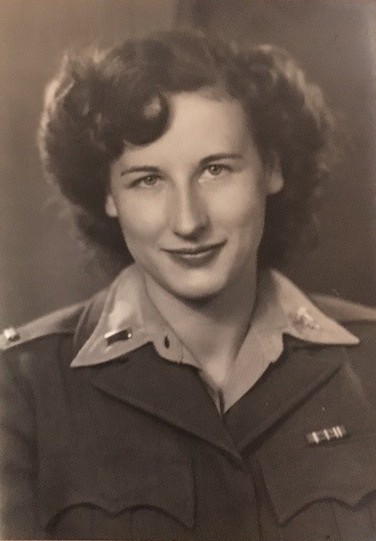
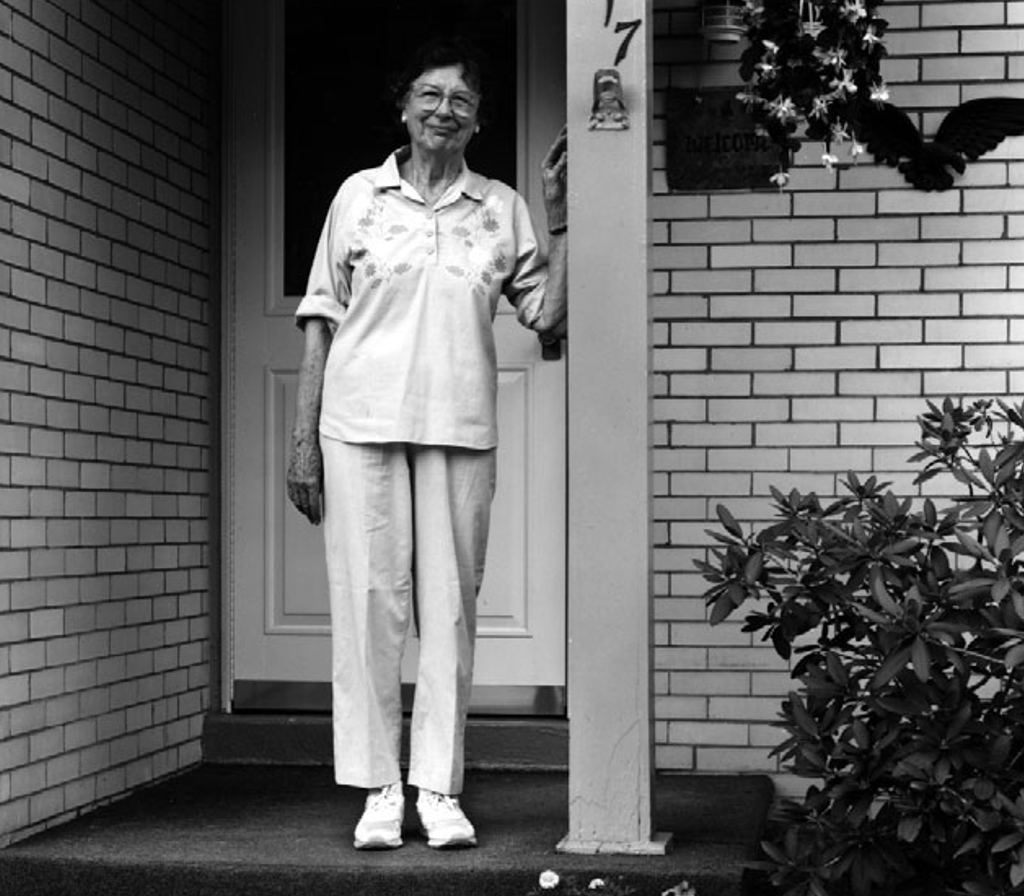
Marjorie Butterfield was born in Pittsburgh’s North Side in 1920. She trained as a registered nurse at Sewickley Valley Nursing School, graduating in 1941. Several months later, she heard about the Pearl Harbor attacks while listening to the radio in her room at the nurses’ home; she enlisted in the US Army in September 1942. Marjorie spent 18 months training at seven different Army camps before landing in Liverpool, England on June 6, 1944 — she heard about D-Day while still on the ship. Marjorie’s unit was attached to the 3rd Army; they landed on Omaha Beach in Normandy on July 31, 1944 and staffed a field hospital, treating the most seriously wounded servicemembers. Later she was stationed in Belgium, where she cared for soldiers injured in the Battle of the Bulge. Marjorie’s unit then moved into southern Germany, then arrived in Linz, Austria in May 1945. At this time they entered the Gusen concentration camp (a subcamp of Mauthausen), where Marjorie treated the survivors upon liberation — mainly, she cared for the female survivors. Marjorie attained the rank of 1st Lieutenant by the end of the war, and later set up and staffed a hospital for the armies of the occupation troops in Czechoslovakia at the war’s conclusion.
Marjorie did not discuss what she had experienced and witnessed at Gusen for over 40 years. Later in life, she became involved with the Holocaust Center of Pittsburgh, and was a strong supporter of Holocaust education. She stated, “after the War, I tried to suppress my awful memories of Gusen. I never talked about it when I returned home. One evening about forty years later I heard a man on television say the Holocaust never happened, that it was all false propaganda. I became very angry and knew it was time to speak up. In the next day’s newspaper I read about a man from the Holocaust Center of Pittsburgh who asked anybody who had any information about concentration camps to get in touch with him. I called right away and have been involved with their programs ever since.”
A long-time resident of the North Hills of Pittsburgh, Marjorie was active in her church, Riverview United Presbyterian, where she taught Sunday school for 50 years. Professionally, she worked as a school nurse in the Shaler Area School District, the career from which she retired after 21 years. Marjorie was married to James Butterfield. She had one daughter and a grandson. Marjorie passed away in Pittsburgh on October 26, 2006.
Gusen: A Nurses Tale by Marjorie Butterfield
We arrived at Gusen Concentration Camp in Austria about two weeks after the camp had been liberated. I was an army nurse, assigned to the 59th Field Hospital.
The camp was surrounded by a high wall, the terrain barren, the buildings drab. Over a thousand men with shaved heads either sat dejectedly on the ground or aimlessly milled about. They were all so emaciated, they looked as if they could hardly stay alive.
Actually many of them didn’t. Every morning, a truck picked up the dead bodies and took a full load to the cemetery nearby.
The patients in the hospital were suffering from tuberculosis, typhus, infec-tions, anemia, and diseases caused by severe vitamin deficiency. When taking care of our wounded soldiers in the Field Hospital we had plenty of antibiotics, whole blood, plasma, and intravenous feedings. Here, there was a tremendous shortage of all these necessities. We felt helpless.
If ever patients needed to be comforted, needed tender loving care, these unfortunate souls did, but it was difficult because of the language barrier. All of us—doctors, nurses, and corpsmen—were given the opportunity to take German lessons. But progress was slow, and I hoped that I could convey by a tender touch or the look on my face that I cared.
Although we had enough food for ourselves, there was not enough for the patients. One day on my way to our mess hall I saw two men boiling chicken feet that had been thrown in the garbage, to make soup. I couldn’t eat my lunch that day.
On the Women’s Ward, there were only about sixty-five patients, and they were in better physical shape than the men. Many were well-educated and could speak English. They were of various nationalities and religions. They told me about the hardships, indignities, and cruelties they had endured. None of them knew what had happened to their families, except for those who had seen them killed or led to the gas chamber.
One day there was great excitement among the women. One of them had started her menstrual period! Stress and malnutrition had caused all of them to cease having periods. Since one of them became a “normal woman” they all felt it would soon happen to them too.
All the nurses longed to see the women smile, and we found how little gifts brought out those bright looks. Since we couldn’t shop in a store, we searched our belongings to give them makeup, underwear, pens, pencils, toothpaste, toothbrushes, and combs.
Our patients were courageously determined to make new lives for them-selves as they began to have hope now that the war was over. Their first goal was to find out about their families, and our Red Cross workers began to search for information for them. But perhaps that hope was in vain as, after two months, the camp was put in the Russian zone of the Army of Occupation, and our hos-pital was sent to Czechoslovakia.
I tried to suppress all the memories of that camp, and refused to talk about it when I returned. But one evening forty years later, I heard a man on television saying that the Holocaust never happened and that it was false propaganda to turn people against the Germans. Then I knew I finally had to speak.
–Flares of Memory: Stories of Childhood During the Holocaust